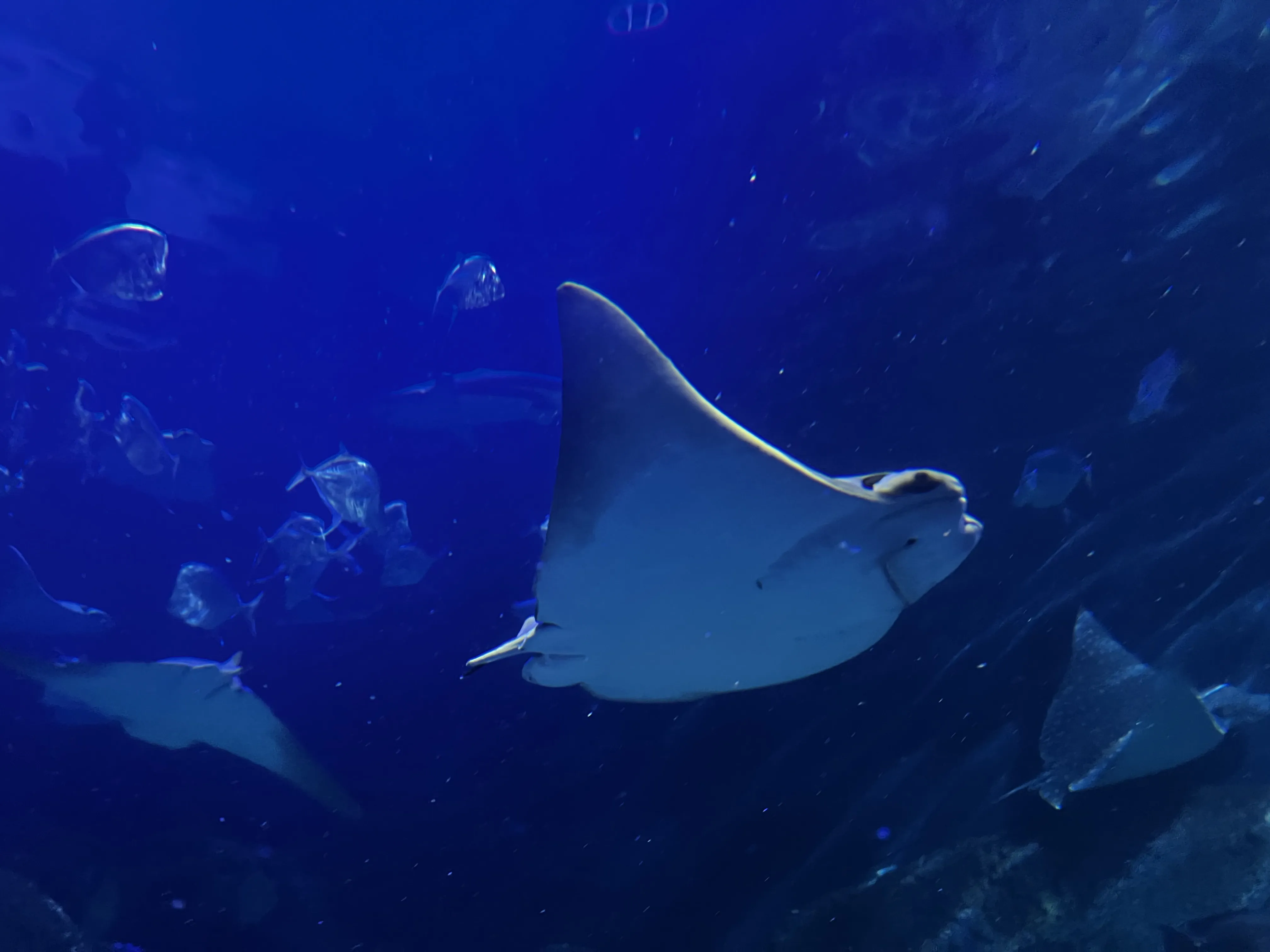
Amazing Rays
There are over 500 different species of stingrays and skate in our oceans and rivers. Their closest relative is the shark; rays evolved from sharks around 150 million years ago!
Just like sharks, rays don’t have a bony skeleton. Instead, their skeleton is made of cartilage (just like our nose and ears!). This makes them lighter so it is easier for rays to glide through the ocean.
Did you know that rays breathe through special holes called spiracles, located just behind their eyes? These allow them to draw in clean, oxygen-rich water while resting on the sea floor or buried in the sand.
Stingrays get their name from the stinging barb at the base of their tail. When they feel threatened, stingrays can whip up their tail to puncture their pursuer with their spiny, venomous barb. Once they have done this, it takes a while for a new one to grow back, so they only use it as a last resort.
In our Stingray Bay, you'll see our happy southern stingrays and Atlantic stingrays as they glide along the sea bed. They also like to bury themselves in the sand! This is a behavior they use in the wild to hide from predators such as great hammerhead sharks and killer whales.
In the wild, cownose stingrays can be found in enormous schools of up to 10,000 individuals! Can you imagine how much they eat?
Can you tell the difference between male and female stingrays? Males have two large, finger-like structures called claspers on either side of their tail. These are used during mating to cling to the female. Female stingrays do not have claspers.
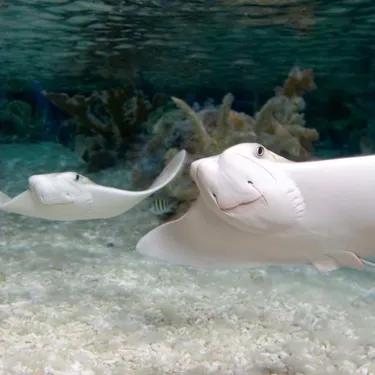
Cownose Ray
They use flat, tile-like teeth to crunch through hard-shelled animals. They migrate in schools of up to 10,000 rays.

Blue-Spotted Maskray
Their exact gestation period is unknown, as some pregnancies are 4 months, while others can be 7. They are often seen buried, with only their eyes exposed as a way of protecting themselves from…

Yellow Stingray
Found in the coastal waters of the tropical western Atlantic ocean (North Carolina through the Caribbean Sea) and they can glow in the dark!

Southern Stingray
Females of this species can grow to be up to 6.5 feet, while males of this species only grow to be about 2.6 feet. Can be found in the Western Atlantic (from New Jersey to Brazil).

Fiddler Ray
Their gestation period is 12 months long! Also called "Bando Rays" for their distinctive shape.
