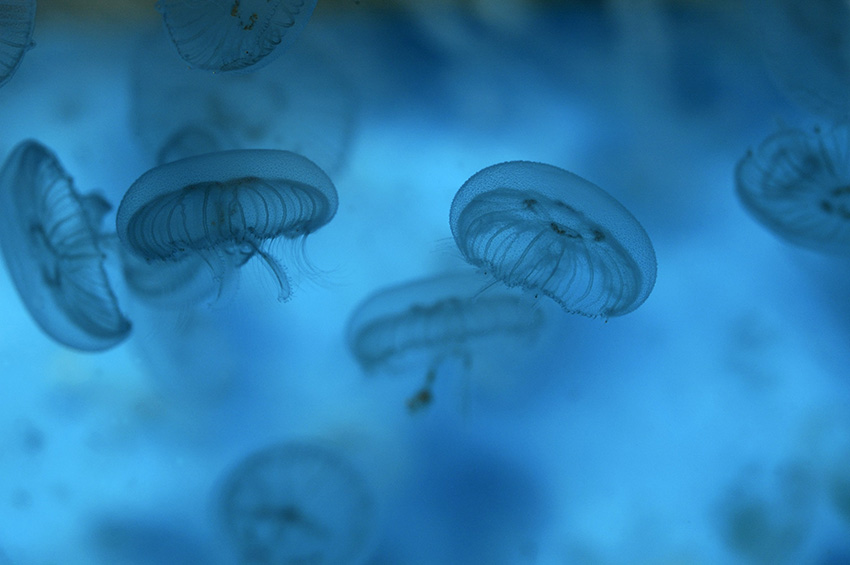
Jellyfish & Corals
In this small area, you can admire delicate moon jellyfish up close. Their graceful, drifting movements seem almost magical. Change the color of the water and watch as the jellyfish glide silently through their underwater world. Take a closer look at the fascinating corals as well, whose vibrant shapes and colors create an important habitat for countless marine species. Together, the jellyfish and corals form a truly mesmerizing ocean scene.

Ear jellyfish
Aurelia aurita
Did you know?
- For over 500 million years, jellyfish have been drifting through the world’s oceans at speeds of up to 10 km/h. By contracting their bellies, jellyfish expel water and propel themselves forward using the principle of thrust. Most of the time, however, they simply let themselves be carried along by ocean currents.
- The jellyfish life cycle begins with tiny eggs that develop into larvae (planulae), which drift through the water until they settle on the seafloor and become polyps. Through budding, the tube-shaped polyps give rise to sac-like ephyra, which eventually grow into free-swimming medusae and continue the cycle through reproduction.
- The ear jellyfish is found in all the world’s oceans and is characterized by four rings in the center of its bell. These are the jellyfish’s reproductive organs. Those of the females are reddish-purple, and those of the males are white to orange.
- Ear jellyfish possess a mild stinging toxin. However, since the jellyfish’s stinging cells cannot penetrate human skin, it poses no danger to humans.

Moorish idol
Zanclus cornutus
Did you know?
- Moorish idol have a spine above their eyes that becomes clearly visible once they reach maturity. This feature is also the origin of their scientific name (Latin: Naso cornutus, meaning “horned”).
- The natural habitat of the Moorish idol is the tropical coral reefs of the Indo-Pacific. They are usually found in groups of two or three individuals or in small schools and are among the most common and widely distributed reef fish in the region.
- Moorish idol are true gourmets. Their diet consists of invertebrates and algae, which they graze using their long, brush-like teeth. This specialized feeding behavior makes them challenging aquarium inhabitants, even though they do not actively try to escape their tanks like Gill in “Finding Nemo”.

Candycane coral
Caulastraea furcata
Did you know?
- The candycane coral is also known as the finger coral.
- The coral feeds primarily on plankton, which it filters from the water at night using its outstretched tentacles.

Pulse coral
Xenia umbellata
Did you know?
- This coral is best known for its unique, pulsating polyps, which give it a particularly lively appearance.
- Xenia can reproduce extremely quickly and form monocultures. They are found in many tropical seas.
- Unlike stony corals, soft corals do not have a solid calcareous skeleton.

Tree coral
Litophyton arboreum
Did you know?
- The tree coral is also known as the tree soft coral.
- It is widespread in the Red Sea and can grow up to 80 cm in size, though its color may vary.
- Like many other corals, the tree coral lives in a close symbiotic relationship with tiny algae (zooxanthellae). These algae provide the coral with essential nutrients and contribute to its growth.
- Studies have shown that the reproductive cells of this coral already contain these algae when they are released. As a result, the beneficial algae are passed directly on to the next generation.

Double whipetail bream
Pentapodus emeryii
Did you know?
- When foraging for food, Emery’s false snappers also sift through the sand. To do this, they take a mouthful of sand and spit out everything indigestible, while small shrimp, snails, and other tasty morsels remain in their mouths and are eaten.
- The beautiful coloration of Emery’s false snappers depends on their surroundings. Depending on their environment, the fish can adapt their colors.
Get your tickets now!
Explore the other areas

Rotterdam Habour
Here, you can experience the vibrant life in one of Europe’s largest ports. Hidden between giant ships and harbor basins are astonishing marine creatures perfectly adapted to the bustling activity and the brackish water. Discover just how diverse and full of life the underwater world can be right in the heart of the harbor!
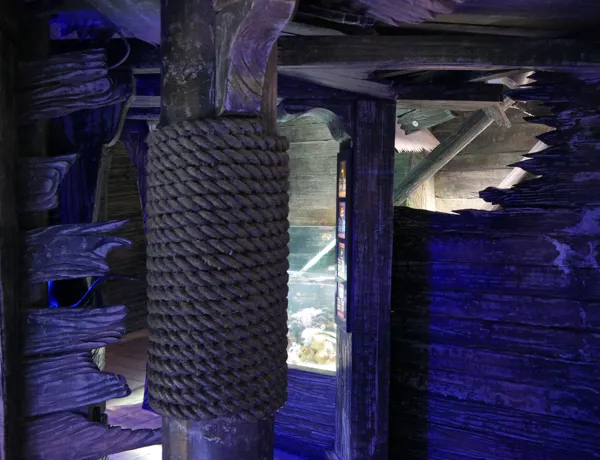
Shipwreck
Between old beams and sunken planks, a very special habitat has formed. Here, you’ll encounter fascinating marine creatures such as moray eels, scorpionfish, and lobsters—perfectly adapted to dark hideaways and hidden corners. Discover the secrets this wreck holds beneath the water’s surface!

North Sea
Here you can experience the fascinating creatures of the North Sea up close. Do you dare to take a peek into the mysterious world of rays and other North Sea animals? Discover just how diverse life is among the waves, mudflats, and rocks!

Tropical Reef
A colorful underwater world teeming with life awaits you here. Clownfish hide among the anemones. The vibrant colors and constant activity in the reef make this habitat a real highlight—discover for yourself just how lively and fascinating the tropical sea can be!
