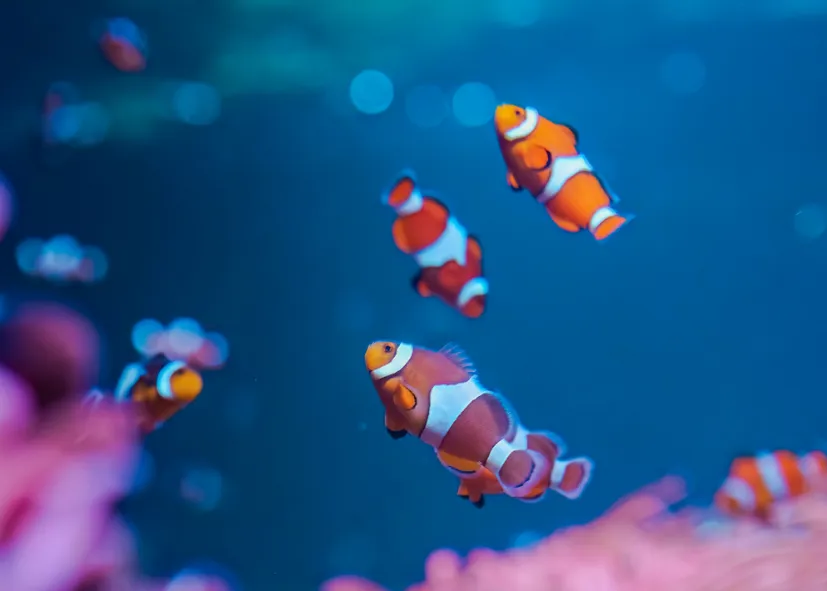
Tropical Reef
A colorful underwater world teeming with life awaits you here. Clownfish hide among the anemones. The vibrant colors and constant activity in the reef make this habitat a real highlight—discover for yourself just how lively and fascinating the tropical sea can be!

Copper-striped Pincersfish
Chelmon rostratus
Did you know?
- The black spot toward the rear of the dorsal fin is known as an “eye spot”; this is an adaptation to predators that focus on the eyes of their prey and thus misjudge the direction in which the copper-striped pincersfishare is fleeing.
- Copper-striped pincersfish are very territorial and live either alone or in pairs.
- With their elongated snouts, the fish peck at their prey, primarily small crabs and mussels.

Clown anemonefish
Amphiprion ocellaris
Did you know?
- The False Clownfish is also known as the Orange Clownfish or False Percula Clownfish.
- A melanistic (black) variant of the False Clownfish can be found in the waters off northern Australia.
- These fish live in symbiosis with sea anemones. The anemones’ tentacles protect the clownfish from predators, while the clownfish help defend the anemones from predators such as butterflyfish and filefish. Clownfish are protected from the anemones’ stinging cells by a special mucus coating. This mucus is acquired from the anemone rather than produced by the fish itself.
- Juvenile fish are carried away by ocean currents and later seek out new symbiotic partners.
- Clownfish live either in pairs or in harem groups, with the largest fish always being the female. If she dies, the next largest male changes sex and becomes the female.
- The False Clownfish can be distinguished from the True Clownfish (Amphiprion percula) by the much thinner black edges around its white bands. This means that Nemo is actually a False Clownfish.

Mandarin fish
Synchiropus splendidus
Did you know?
- The mandarin fish has no scales, but rather a very tough skin covered with a layer of mucus. This layer emits a foul odor when it comes into contact with air.
- Male fish have a distinctly elongated dorsal fin ray.
- The mandarin fish’s coloration is produced by so-called dichromatic chromatophores, a feature found only very rarely in the animal kingdom.
- To mate, the pair dances together belly-to-belly in a ritual at dusk.
- The mandarin fish gets its name from its colorful pattern, which resembles the robes of Chinese imperial civil servants (the mandarins).
Get your tickets now!
Explore the other areas

Ocean Tunnel
In the Ocean Tunnel, you’re right in the middle of the action instead of just a spectator: The glass ceiling offers a fascinating view into the world beneath the waves. Here, Leo—the impressive zebra shark—welcomes you along with his fascinating tank mates. As he glides elegantly through the water, other sharks and colorful sea creatures swim silently past and alongside you. An unforgettable spectacle right above your head.

Rainforest
Hidden in the heart of the rainforest lies a mysterious habitat teeming with biodiversity. Among the roots, submerged tree trunks, and dense tangle of vegetation, piranhas, bonefish, and other fascinating inhabitants glide through the warm, murky water.

Antarctica
Extreme conditions prevail in the icy world of Antarctica, yet amazing animals call this place home. Among shimmering ice floes and cold, crystal-clear water, you’ll encounter curious gentoo penguins and other inhabitants that are perfectly adapted to the freezing waters.

Glacier Cave
Welcome to the mysterious world of the glacier cave! Here you'll discover animals that have perfectly adapted to the freezing cold and life beneath the glacier.
