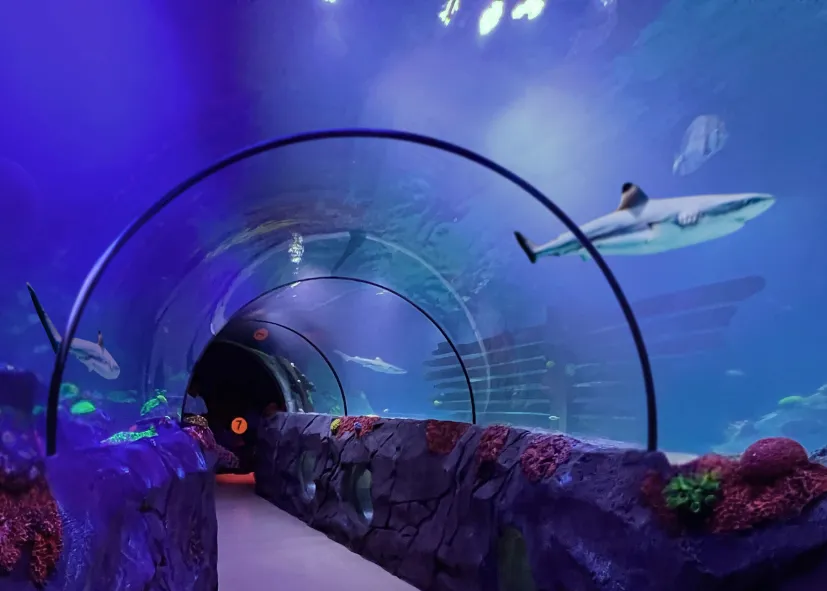
Ozeantunnel
In the Ocean Tunnel, you’re right in the middle of the action instead of just a spectator: The glass ceiling offers a fascinating view into the world beneath the waves. Here, Leo—the impressive zebra shark—welcomes you along with his fascinating tank mates. As he glides elegantly through the water, other sharks and colorful sea creatures glide silently past and alongside you. An unforgettable spectacle right above your head.

Zebra Shark
Stegostoma fasciatum
Did you know?
- Although adult zebra sharks have spots, the young hatch from their eggs with stripes. This black-and-white coloration serves as camouflage and resembles the striped pattern of their namesakes.
- Our male zebra shark, Leo, is of average size at 240 cm. However, some individuals can grow to over 3 meters in length, with the tail accounting for nearly half of that length.
- Despite their size, these slow-moving animals squeeze through narrow crevices and caves in search of food. They prefer mollusks, crustaceans, and small fish.

Blacktip Reef Shark
Carcharhinus melanopterus
Did you know?
- Blacktip reef sharks can be distinguished from one another by their coloration. While the gray base color, the light-colored belly, and the black tip of the dorsal fin are the same in all individuals, the fins vary in the intensity of their black coloration.
- The teeth in the upper and lower jaws differ significantly from one another.
- Thanks to a reflective layer behind the retina, sharks can perceive their surroundings even in minimal light conditions.
- Since the gill muscles of blacktip reef sharks are not particularly well-developed, the fish must swim constantly. They do not stop swimming even while sleeping.
- Unlike the zebra shark, blacktip reef sharks are viviparous. After a gestation period of 9–16 months, between 2 and 6 pups are born.

Brown-banded Bamboo Shark
Chiloscyllium punctatum
Did you know?
- The horizontal stripes that give the brown-banded bamboo shark its name fade over the course of its life, so that older individuals sometimes lose their markings entirely.
- Bamboo sharks can walk on their fins. This helps them move from one tidal pool to the next and cross shallow reefs. In addition, these sharks can survive out of the water for a certain amount of time. Their moist gills and high tolerance for oxygen deprivation help them do this.

Redtooth Triggerfish
Odonus niger
Did you know?
- Triggerfish have particularly strong jaws, which they use to crush rocks, sponges, and shells while foraging.
- The redtooth triggerfish is a relatively harmless member of the triggerfish family and significantly less aggressive than some of its relatives.
- Because their pectoral fins are very small, these fish steer primarily with their dorsal and anal fins, which makes them particularly agile and allows them to move using a propeller-like swimming technique.

Palette Surgeonfish
Paracanthurus hepatus
Did you know?
- While juvenile palette surgeonfish live in schools, adults travel alone or in pairs.
- Surgeonfish get their name from the sharp blade at the base of their tail, which resembles a surgical scalpel. This blade serves as a defense against predators and is also used in fights among members of the same species.
- Palette surgeonfish can live up to 20 years.
- Palette surgeonfish feed on algae from coral reefs. In doing so, they prevent the algae from overgrowing the corals. They thus make an important contribution to the balance and health of the reefs.
Get your tickets now!
Explore the other areas

Rainforest
Hidden in the heart of the rainforest lies a mysterious habitat teeming with biodiversity. Among the roots, submerged tree trunks, and dense tangle of vegetation, piranhas, bonefish, and other fascinating inhabitants glide through the warm, murky water.

Antarctica
Extreme conditions prevail in the icy world of Antarctica, yet amazing animals call this place home. Among shimmering ice floes and cold, crystal-clear water, you’ll encounter curious gentoo penguins and other inhabitants that are perfectly adapted to the freezing waters.

Glacier Cave
Welcome to the mysterious world of the glacier cave! Here you'll discover animals that have perfectly adapted to the freezing cold and life beneath the glacier.

Mountain stream
Dive into the world of the mountain stream! Here you'll discover animals that have perfectly adapted to the clear, cool water and the fast-moving current
