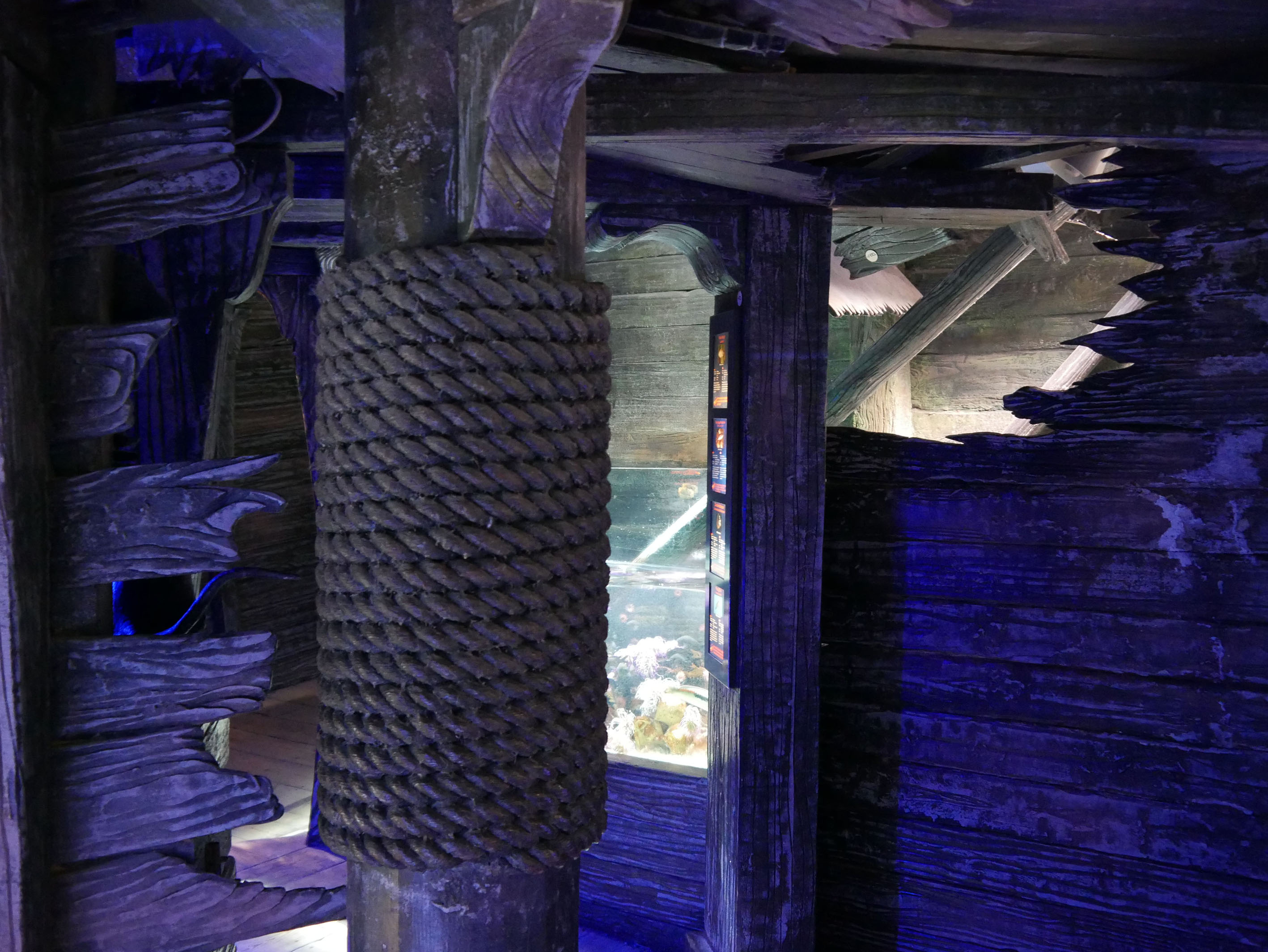
Shipwreck
A very special habitat has formed among the old beams and sunken planks. Here you’ll encounter fascinating marine life such as moray eels, scorpionfish, and lobsters—perfectly adapted to dark hiding spots and hidden nooks. Discover the secrets this wreck holds beneath the surface!v

Sea Junker
Coris julis
Did you know?
- Among sea skippers, there are females, primary males (from birth), and secondary males (which develop from females). The latter display a particularly striking pattern, while females and primary males tend to have more subdued colors.
- The transformation of females into secondary males takes several weeks and is triggered by the absence of males.
- As a rule, females mate with secondary males. Only rarely does a primary male have the opportunity to fertilize the eggs.
- Depending on the population (different ranges), there are differences in the body structure of sea skippers.
- To sleep, sea skippers burrow up to 5 cm deep into the ground.

Monkfish
Chromis chromis
Did you know?
- Before the construction of the Suez Canal, the monkfish was the only species of reef bass in the Mediterranean.
- Monkfish can live up to 9 years.
- During the day, the monkfish has a different coloration than at night. This is particularly noticeable in individuals that sleep in open water. Fish that sleep hidden on the reef rarely change their coloration. In winter, however, most monkfish take on their nighttime coloration to remain well-camouflaged in low-light conditions.
- Monkfish prefer to live in loose schools, with the size of a population depending on the available hiding places.
- Females and males look exactly alike. This is called “monomorphic sexual dimorphism.”
- During the spawning season, males establish short-lived territories where they attract females to lay their eggs; they then guard the clutch until the eggs hatch. In addition to territorial males, small males without territories use cunning strategies as “sneaks” and “pseudo-females” to fertilize eggs.
-
Male monkfish take full responsibility for caring for the eggs. They fan them with fresh water, keep them clean, and protect them from predators. During this time, they hardly sleep or

Common Spiny Lobster
Palinurus elephas
Did you know?
- Common spiny lobsters can grow up to 50 cm in length, but on average they measure 25–30 cm. Their antennae are usually longer than their bodies, which can weigh 2–4 kg.
- Spiny lobster eggs are reddish in color.
- Common spiny lobsters are nocturnal. At night, they forage for worms, small crabs, or carrion.
- Spiny lobsters are found near the shore but can also be found at depths of up to 200 m. They prefer environments with plenty of holes and caves to hide in during the day.
- Unlike their relatives, the lobsters, spiny lobsters do not have claws.

Red Scad
Scorpaena scrofa
Did you know?
- The red scorpionfish is also known as the sea pig.
- This fish can grow up to 50 cm in length and weigh up to 3 kg.
- As a bottom-dwelling ambush predator, the scorpionfish does not need a swim bladder.
- Scorpionfish shed their skin at regular intervals.
- Its red color is a warning that the scorpionfish is not to be trifled with: the venom from its spines can be fatal to humans and, at best, causes severe pain that lasts for months.
- Despite all this, the red scorpionfish is a popular and tasty edible fish.

Moray eels
Muraene helena
Did you know?
- There are over 200 different species of moray eels. The largest species is the giant moray eel, which can grow up to 4 m in length. The smallest species is the Snyder’s moray eel, which is about 12 cm long.
- At SEA LIFE Konstanz, you can find the Mediterranean moray eel and the Prince August moray eel.
- Moray eels have neither pectoral nor pelvic fins, nor do they have scales. Instead, they are covered with a protective layer of mucus, which is toxic in some moray eels. Incidentally, the blood of moray eels is also toxic, as is, in some cases, the mucous membrane of their mouths, which is why a moray eel bite can be very painful.
- Moray eels have two sets of teeth. The second set, located in the throat, is used to pull food toward the stomach.
- Since moray eels lack gill covers, they must pump water through their gills by regularly opening and closing their mouths.
- While moray eels do not have very good eyesight, they can rely entirely on their sense of smell and use it when hunting.
- Moray eels are sedentary and often share their burrows with cleaner fish and cleaner shrimp.

Yellow polyps
Parazoanthus axinellae
Did you know?
- The Yellow polyps, like all anemones, is not a plant but an animal. It belongs to the zoanthids, a group closely related to corals. Zoanthids differ from true sea anemones in both their structure and their colony-forming lifestyle, in which individual polyps are connected to one another by a shared tissue.

Mediterranean flagfish
Anthias anthias
Did you know?
- Mediterranean bannerfish prefer to live in small schools and are light-shy.
- These fish are proterogynous hermaphrodites. This means they are born as females and some later transform into males. They then live in harem groups consisting of one male and several females.
- Male Mediterranean bannerfish can be identified by their elongated pelvic fin and the extended third ray of the dorsal fin.
Get your tickets now!
Explore the other areas

North Sea
Here you can experience the fascinating creatures of the North Sea up close. Do you dare to take a peek into the mysterious world of rays and other North Sea animals? Discover just how diverse life is among the waves, mudflats, and rocks!

Tropical Reef
A colorful underwater world teeming with life awaits you here. Clownfish hide among the anemones. The vibrant colors and constant activity in the reef make this habitat a real highlight—discover for yourself just how lively and fascinating the tropical sea can be!

Ocean Tunnel
In the Ocean Tunnel, you’re right in the middle of the action instead of just a spectator: The glass ceiling offers a fascinating view into the world beneath the waves. Here, Leo—the impressive zebra shark—welcomes you along with his fascinating tank mates. As he glides elegantly through the water, other sharks and colorful sea creatures swim silently past and alongside you. An unforgettable spectacle right above your head.

Rainforest
Hidden in the heart of the rainforest lies a mysterious habitat teeming with biodiversity. Among the roots, submerged tree trunks, and dense tangle of vegetation, piranhas, bonefish, and other fascinating inhabitants glide through the warm, murky water.
