
Rockpool

Get up close and personal with the sea creatures!
At our Discovery Pool, you can literally get up close and personal and learn interesting facts about marine life! Visitors of all ages can discover real shark and ray eggs and even gently feel the cleaner shrimp nibbling gently on their fingers.
So, roll up your sleeves, wash your hands—and let’s get started!

Glass Shrimp
Palaemon varians
Did you know?
- Glass shrimp are also called swimming shrimp or brackish-water shrimp. They live in both brackish water and shallow coastal lagoons.
- The females’ bodies are more greenish than those of the transparent males.
- Glass shrimp are omnivores; they even eat other shrimp.

Netted cushion starfish
Oreaster reticulatus
Did you know?
- The name “net-patterned” comes from the distinctive pattern of short, blunt spines that form a net-like pattern on its body. This pattern is particularly visible in adult animals.
- It can reach up to 50 cm in diameter and has a massive, cushion-like body with broad arms that taper to a point at the front.
- Juveniles are usually green, while adults appear in shades of red, brown, or yellow with contrasting patterns.
- To feed, the cushion star everts its stomach out of its body and digests its food outside its body.
- It lives in the tropical western Atlantic—from South Carolina to Brazil—as well as around the Cape Verde Islands. It is often found on sandy bottoms or among seagrass at depths of up to 35 meters.

Hermit crabs
Paguroidea
Did you know?
- Hermit crabs do not have a shell on their abdomen. Therefore, they look for a suitable shell to protect themselves. Most often, these are snail shells, but due to ocean pollution, crabs can also be found using tin cans as shells.
- As a hermit crab grows, it must molt. Eventually, it becomes too big for its snail shell and looks for a new one. During this relocation, a whole chain of hermit crabs may form, with each one taking over the next larger shell from the previous occupant.
- The anemone hermit crab (Dardanus pedunculatus) also carries anemones on its shell. These “pets” serve as additional protection; the crab cares for them and takes them along when moving to a new home.

Cleaner shrimp
Lysmata
Did you know?
- At SEA LIFE Konstanz, we have two different species of cleaner shrimp: the Indo-Pacific white-banded cleaner shrimp (Lysmata amboinensis) and the fire shrimp (Lysmata debelius).
- When cleaner shrimp are hungry, they perform a little dance to let the fish know that the cleaning station is open.
- In addition to dead scales, they also eat parasites, which is why even predatory fish leave the shrimp alone while they’re being cleaned.
- Our shrimp aren’t picky; instead of fish, they’re also happy to clean our guests’ hands.
Get your tickets now!
Explore the other areas

Jellyfish
In this small area, you can marvel at the delicate moon jellyfish up close. Their floating movements appear almost magical – change the color of the water and watch how the jellies glide by in complete silence.

Rotterdam Habour
Here, you can experience the vibrant life in one of Europe’s largest ports. Hidden between giant ships and harbor basins are astonishing marine creatures perfectly adapted to the bustling activity and the brackish water. Discover just how diverse and full of life the underwater world can be right in the heart of the harbor!
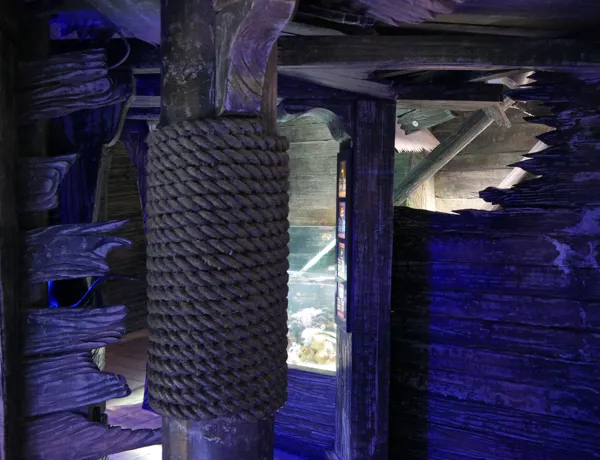
Shipwreck
Between old beams and sunken planks, a very special habitat has formed. Here, you’ll encounter fascinating marine creatures such as moray eels, scorpionfish, and lobsters—perfectly adapted to dark hideaways and hidden corners. Discover the secrets this wreck holds beneath the water’s surface!

North Sea
Here you can experience the fascinating creatures of the North Sea up close. Do you dare to take a peek into the mysterious world of rays and other North Sea animals? Discover just how diverse life is among the waves, mudflats, and rocks!
