Jellyfish
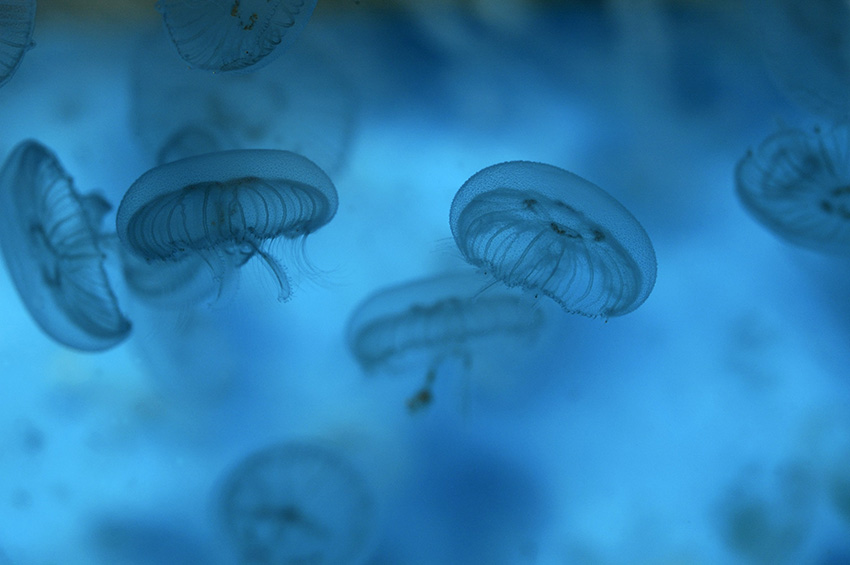
In this small area, you can marvel at the delicate moon jellyfish up close. Their floating movements seem almost magical—change the color of the water and watch as the jellyfish glide silently by.

Ear jellyfish
Aurelia aurita
Did you know?
- For over 500 million years, jellyfish have been drifting through the world’s oceans at speeds of up to 10 km/h. By contracting their bellies, jellyfish expel water and propel themselves forward using the principle of thrust. Most of the time, however, they simply let themselves be carried along by ocean currents.
- The jellyfish life cycle begins with tiny eggs that develop into larvae (planulae), which drift through the water until they settle on the seafloor and become polyps. Through budding, the tube-shaped polyps give rise to sac-like ephyra, which eventually grow into free-swimming medusae and continue the cycle through reproduction.
- The ear jellyfish is found in all the world’s oceans and is characterized by four rings in the center of its bell. These are the jellyfish’s reproductive organs. Those of the females are reddish-purple, and those of the males are white to orange.
- Ear jellyfish possess a mild stinging toxin. However, since the jellyfish’s stinging cells cannot penetrate human skin, it poses no danger to humans.
Get your tickets now!
Explore the other areas

Rotterdam Habour
Here, you can experience the vibrant life in one of Europe’s largest ports. Hidden between giant ships and harbor basins are astonishing marine creatures perfectly adapted to the bustling activity and the brackish water. Discover just how diverse and full of life the underwater world can be right in the heart of the harbor!
Shipwreck
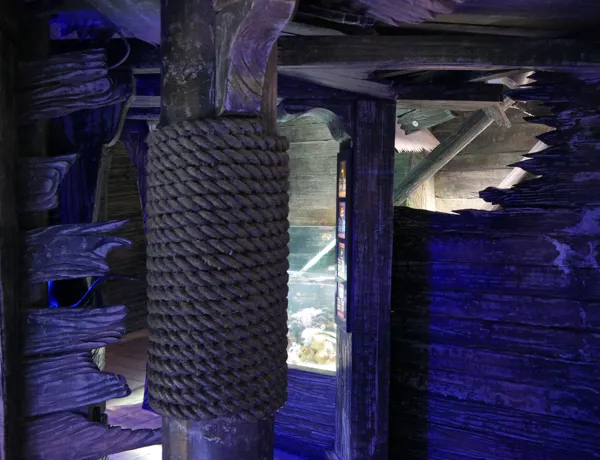
Between old beams and sunken planks, a very special habitat has formed. Here, you’ll encounter fascinating marine creatures such as moray eels, scorpionfish, and lobsters—perfectly adapted to dark hideaways and hidden corners. Discover the secrets this wreck holds beneath the water’s surface!

North Sea
Here you can experience the fascinating creatures of the North Sea up close. Do you dare to take a peek into the mysterious world of rays and other North Sea animals? Discover just how diverse life is among the waves, mudflats, and rocks!

Tropical Reef
A colorful underwater world teeming with life awaits you here. Clownfish hide among the anemones. The vibrant colors and constant activity in the reef make this habitat a real highlight—discover for yourself just how lively and fascinating the tropical sea can be!
