
Lake Constance
Right on our doorstep lies a truly unique habitat: Lake Constance.
Here you can discover everything about the native fish species and their fascinating underwater world.

Common carp / Mirrow carp
Cyprinus carpio
Schon gewusst?
- Carp originally came from Asia, but the Romans brought them to Europe long ago.
- At SEA LIFE Konstanz, you can discover two different types of carp: the common carp (see image) and another domesticated form, the mirror carp. In the Middle Ages, mirror carp were bred to have as few scales as possible to make descaling easier for consumption.
- Wild carp are threatened with extinction in Germany. Due to hybridization with common carp, pure wild carp are now extremely rare, and cultivated forms increasingly displace the wild type.
- A well‑known domesticated form of carp is the koi. These fish are bred in a variety of bright colors and can be extremely valuable.
- Carp are true omnivores with a unique digestive system: they do not have a stomach. Food therefore passes directly into the midgut after being crushed by their pharyngeal teeth.

Common nase
Chondrostoma nasus
Schon gewusst?
- Nases are very sensitive to environmental pollution and are therefore considered indicators of clean water.
- The nase gets its name from the extension of its head above the mouth, which looks like a nose.
- Nases have a prominent lower lip with a sharp, horn‑like edge. This is used to scrape algae from surfaces.
- During the spawning season, nases develop what is known as the spawning rash, which appears as many small white spots on the head area of the fish.

Brown trout
Salmo trutta fario
Schon gewusst?
- The brown trout has expanded its habitat with the help of humans. Following English colonization, it can now be found worldwide, except in northern and central Asia.
- It is even found in waters at altitudes of up to 2,800 meters.
- Brown trout are very site‑faithful. They remain in the area where they were born throughout their entire lives.

Russian sturgeon
Acipenser gueldenstaedtii
Schon gewusst?
-
Sturgeons do not have scales. Instead, their bodies are protected by bony plates.
Sturgeons can live in both saltwater and freshwater. They can reach lengths of up to 230 cm and a maximum age of about 50 years. -
When searching for food on the bottom, their four barbels and the electroreceptors on their snout help them locate small invertebrates.
-
The Russian sturgeon is an important source of caviar. Due to overfishing and poaching, its populations have declined sharply, and it is now considered an endangered species.
-
Russian sturgeons are also popular pond fish, as they can even become tame.
-
At SEA LIFE Konstanz, you can also find a relative of the Russian sturgeon: the sterlet (Acipenser ruthenus). It is significantly smaller, prefers flowing waters, and has a narrower snout than the Russian sturgeon.
Get your tickets now!
Explore the other areas

Rockpool
In the Rockpool area, you can observe fascinating animals up close. Do you dare to gently place your hand in the water and explore their world?

Jellyfish
In this small area, you can marvel at the delicate moon jellyfish up close. Their floating movements appear almost magical – change the color of the water and watch how the jellies glide by in complete silence.

Rotterdam Habour
Here, you can experience the vibrant life in one of Europe’s largest ports. Hidden between giant ships and harbor basins are astonishing marine creatures perfectly adapted to the bustling activity and the brackish water. Discover just how diverse and full of life the underwater world can be right in the heart of the harbor!
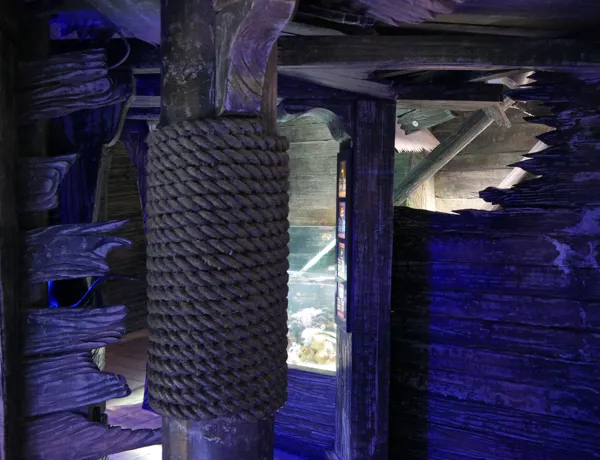
Shipwreck
Between old beams and sunken planks, a very special habitat has formed. Here, you’ll encounter fascinating marine creatures such as moray eels, scorpionfish, and lobsters—perfectly adapted to dark hideaways and hidden corners. Discover the secrets this wreck holds beneath the water’s surface!
