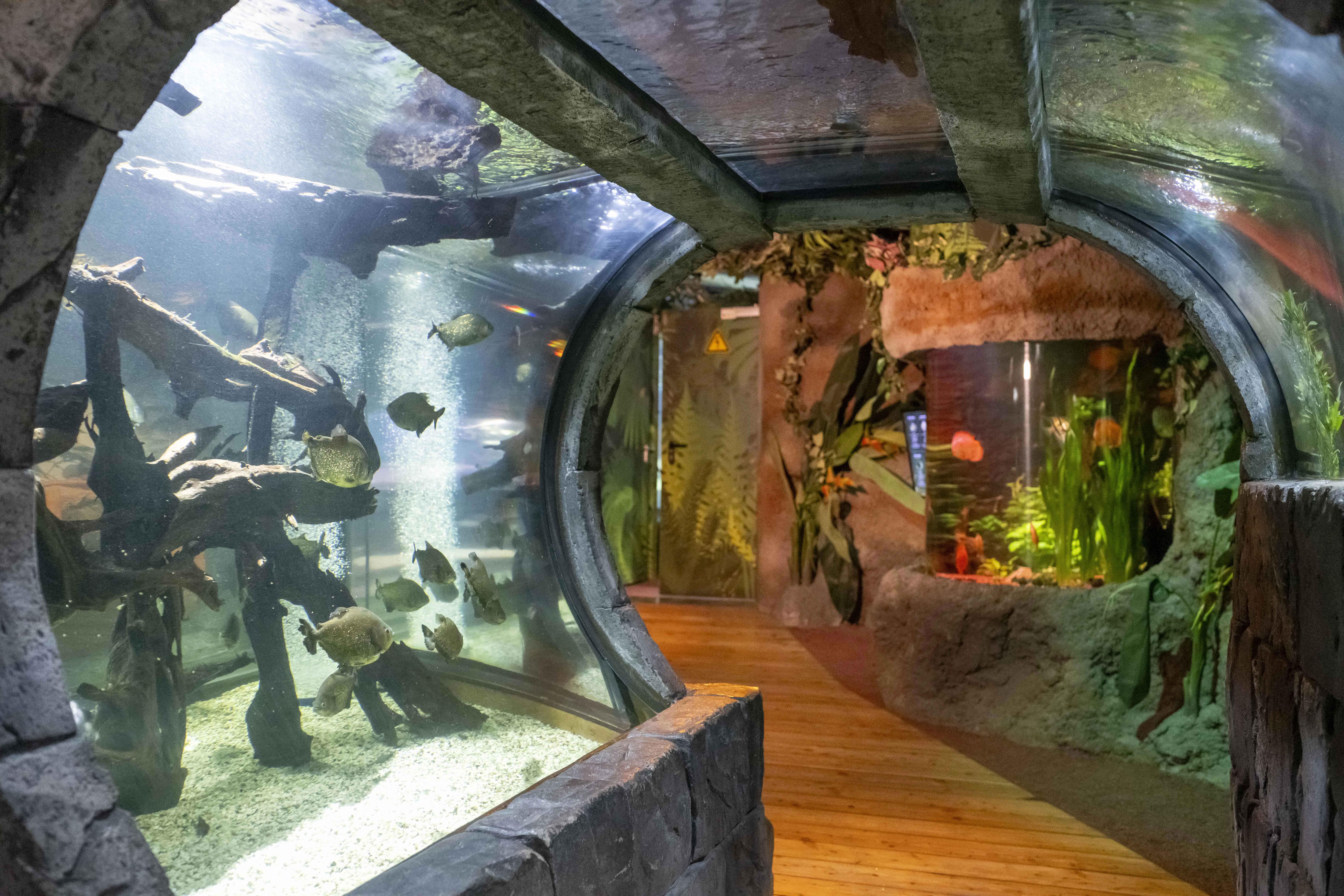
Rainforest
Hidden in the heart of the rainforest lies a mysterious habitat teeming with biodiversity. Among the roots, submerged tree trunks, and dense tangle of vegetation, piranhas, bonefish, and other fascinating inhabitants glide through the warm, murky water.

Giant African land snail
Achatina reticulata
Did you know?
- Giant African land snails can grow up to 20 cm long and weigh up to 500 grams, making them some of the largest land snails in the world.
- To eat, they use a radula, a specialized tongue covered with tiny teeth that rasp food away.
- Giant African land snails should never be kept alone. They are social animals, and solitary housing can cause them stress.
- They are hermaphrodites and can store sperm for up to two years. After fertilization, they lay 100 to 500 eggs in a self-dug chamber in the soil.

Spotted gar
Lepisosteus oculatus
Did you know?
- Spotted gar fish have existed for more than 100 million years. They have retained many characteristics of their prehistoric ancestors and are therefore often referred to as “living fossils.”
- Unlike most fish, gar have hard, diamond-shaped ganoid scales that interlock like armor. These scales are covered with an enamel-like layer and provide excellent protection against predators.
- Spotted gar possess a unique, highly vascularized swim bladder that functions similarly to a lung. This allows them to gulp air at the water’s surface in addition to breathing through their gills, enabling them to survive even in oxygen-poor waters.

Ocellate river stingray
Potamotrygon motoro
Did you know?
- At the base of its tail, the ocellate river stingray has a venomous barb, and injuries caused by it are extremely painful. If a ray hidden in the sand is accidentally stepped on, it may strike with its tail. In South America, accidents involving these animals occur every year.
- Unlike many fish species, the ocellate river stingray does not lay eggs. After a gestation period of about three to four months, the female gives birth to 1 to 12 fully developed pups.
- The ocellate river stingray can detect even the smallest electrical signals produced by its prey using specialized sensory organs.This allows it to locate food in murky water or even when it is hidden beneath the sand.
- Ocellate river stingray are remarkably intelligent and capable of learning. In aquariums, they can recognize their caretakers, adapt to regular feeding schedules, and actively explore their surroundings. Their curiosity and adaptability make them one of the most intelligent fish species commonly kept in aquariums.

Speckled piranha
Serrasalmus maculatus
Did you know?
- Speckled piranhas can generate a bite force that, relative to their body size, is among the strongest in the animal kingdom. Their razor-sharp teeth can effortlessly cut through flesh, scales, and even small bones.
- Young speckled piranhas are often silvery or speckled grey. As they mature, they gradually develop their characteristic dark to almost black coloration.
- Contrary to the popular myth of large, coordinated schools of piranhas hunting together, black piranhas often live in small groups or alone and aggressively defend their territory against other fish.
- Speckled piranhas can produce a variety of sounds, including grunts and clicking noises. These sounds are used for communication, such as warning rivals or defending their territory.
-
Male speckled piranhas are often responsible for guarding the eggs and will aggressively defend their nest against intruders.
Get your tickets now!
Explore the other areas

Antarctica
Extreme conditions prevail in the icy world of Antarctica, yet amazing animals call this place home. Among shimmering ice floes and cold, crystal-clear water, you’ll encounter curious gentoo penguins and other inhabitants that are perfectly adapted to the freezing waters.

Glacier Cave
Welcome to the mysterious world of the glacier cave! Here you'll discover animals that have perfectly adapted to the freezing cold and life beneath the glacier.

Mountain stream
Dive into the world of the mountain stream! Here you'll discover animals that have perfectly adapted to the clear, cool water and the fast-moving current

Lake Constance
Right on our doorstep lies a unique habitat: Lake Constance. Here, you can learn all about the native fish species and their fascinating underwater world.
