Why Do the Penguin Exhibits Draw Their Curtains in the Evening?
- Friday August 21st 2026
- About Our Animals

When we think of the star attractions from the world’s coldest regions, penguins are always at the top of the list. With their adorably clumsy waddle and black-and-white feathers that look like a tuxedo, they have affectionately earned the nickname Business Geese. But beneath that undeniable cuteness lies a creature far more sensitive to light and time than most people realize.
Light is a penguin’s biological clock
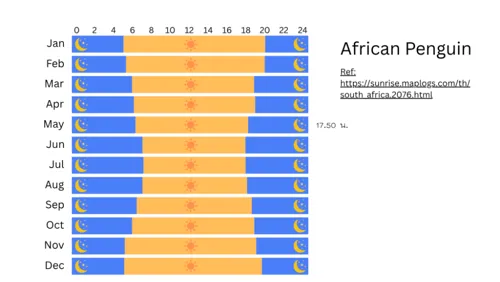
A penguin’s annual life cycle is heavily dictated by photoperiod—the amount of light they receive each day. This light serves as a natural trigger that regulates molting, breeding, hormone levels, and daily behaviors.
In their natural habitats across the Southern Hemisphere, the length of day and night changes dramatically with the seasons. This is due to the Earth’s axial tilt of about $23.5^\circ$ as it orbits the sun. At certain times of the year, days are exceptionally long, while at others, they are incredibly short. These drastic shifts are nature’s way of telling the penguins exactly when it is time to adapt their lifestyle. 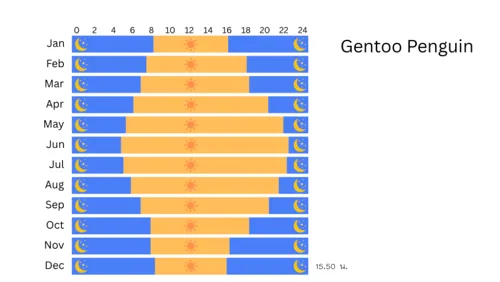
Replicating nature inside the exhibit
At SEA LIFE Bangkok, caring for our penguins means replicating nature as closely as possible. We carefully adjust the periods of light and darkness, simulate natural sunrises and sunsets, and even shift the lighting to match the changing seasons.
Our exhibit is home to two different species: the African penguin from South Africa and the Gentoo penguin from the Antarctic Peninsula. Because these two species come from entirely different regions, their seasons and light cycles vary, requiring highly specific, tailored light management for each group.
So, why the need to draw curtains?
Even though we have strict control over the internal lights, external lights such as ambient glare from neighboring animal exhibits can still seep in.
To a penguin, even a tiny amount of stray light can disrupt their perception of time and throw their natural biological rhythms out of sync. Drawing the curtains shut creates a solid, uninterrupted darkness that mimics a true night, allowing their internal biological clocks to function exactly as nature intended.
Get to know our penguins a little better
Every penguin species has its own unique flair
-
The Gentoo penguin - Recognizable by the prominent white stripe draped across the top of their head, paired with bright orange bills and feet.
-
The African penguin - Also known as the Jackass penguin, this is the only species found on the African continent. They stand out with a horseshoe-shaped black stripe across their chest, pink glands above their eyes used for cooling down, unique black spots on their bellies, and a loud braying call that sounds just like a donkey.
And that dapper tuxedo look? It is actually a brilliant camouflage technique called countershading. Their dark backs blend seamlessly with the deep ocean when viewed from above, while their white bellies match the bright sky when viewed from below, keeping them safe from predators.
Fun fact: SEA LIFE Bangkok is currently the only place in Thailand where you can see both of these incredible species living side by side.
Small details, big impacts
Sometimes, simply dimming the lights can mean the world to an animal, allowing them to live a life that is as close to nature as possible.
The next time you visit our penguins and see the curtains drawn, remember that it isn’t just a piece of fabric—it is a vital part of ensuring our feathered friends live a healthy, happy life every single day.
