From Egg to Adult: Life Cycles and Classification on a Guided Excursion to SEA LIFE Sydney Aquarium
- Thursday 27th August 2026
- Schools
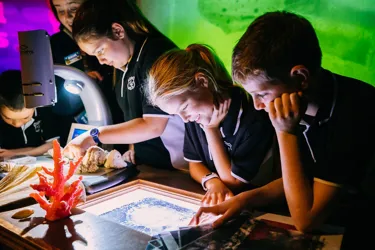
Textbooks can explain that a clownfish starts life as an egg, or that a shark is a cartilaginous fish rather than a bony one — but watching a nursery of juvenile fish sheltering in an anemone, or comparing a ray's flattened body to a shark gliding overhead, is where classification and life cycles actually click for students.
At SEA LIFE Sydney Aquarium, more than 700 species across freshwater and marine environments give students a living case study in how scientists group, name and track organisms through every stage of their lives.
Watching Life Cycles Unfold
From seahorse fry bred in the aquarium's own seahorse breeding lab to turtles, jellyfish and reef fish at different life stages, students can observe:
- Metamorphosis and growth — how form and behaviour change from juvenile to adult
- Reproductive strategies — egg layers, live bearers, and the parenting (or lack of it) that follows
- Survival at each stage — why early life stages are the most vulnerable, and how habitats support them
Classification in Practice
Sorting animals into groups is a core Living World skill — and the aquarium's zones make it visual rather than abstract. Students can compare:
- Vertebrates vs invertebrates
- Cartilaginous vs bony fish
- Adaptations that link to classification, such as camouflage, gill structure and body shape
Curriculum Connections
Science (Living World, K–10)
- Life cycles, growth and change
- Classification of living things
- Structural adaptations and their function
Science 7–10 Syllabus (2023)
- Classification systems and biological diversity
- Reproduction and life cycles across taxa
HSIE / Geography
- Habitats and the conditions organisms need to survive at each life stage
Make It a Guided Excursion
Self-guided visits let classes explore at their own pace, but a Guided School Excursion Tour puts one of SEA LIFE's educators in front of your students for a full hour, walking them through Lifecycle and Classification & Adaptation content mapped directly to the Living World strand. It's the difference between students seeing the animals and understanding what they're looking at — with an expert on hand to answer the questions a worksheet can't.
Guided tours are available for all year levels K–12, run in capped groups of up to 30 students, and can be booked as a single-attraction visit or combined with WILD LIFE Sydney Zoo, Madame Tussauds Sydney or Sydney Tower Eye for a full day of cross-curricular learning.
Learn More About Guided ToursFAQs
Yes! Guided tours are designed for K–12 audiences, with educators adjusting language and depth to suit the group. For early-stage classes, it's often the easiest way to keep a life cycles lesson hands-on without the logistics falling on accompanying teachers.
Absolutely. Many schools book a guided tour at SEA LIFE Sydney Aquarium in the morning, and then a guided tour at WILD LIFE Sydney Zoo or a self-guided tour at Madame Tussauds Sydney or Sydney Tower Eye.
Self-guided teacher resource guides covering Life Cycles, Habitats, Adaptations and Conservation are available to all schools and can be used to extend a guided tour visit back in the classroom.
